Filter by
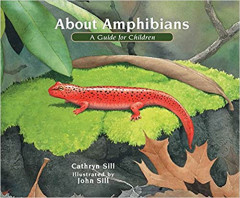
About amphibians : a guide for children
Frogs and toads and salamanders – oh my! A first look at amphibians from the creators of the award-winning About… and About Habitats series. “A very fine easy-reading introduction to amphibians that will be savored by young viewers and teachers.” ―Kirkus Reviews In this addition to the acclaimed About… series, former educator and author Cathryn Sill uses simple, easy-to-unders…
- Edition
- -
- ISBN/ISSN
- 9781561453122
- Collation
- 40 pages : illustration ; 21 cm
- Series Title
- -
- Call Number
- 597.8 SIL
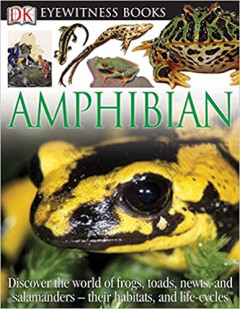
Amphibian
Frogs, toads, newts, salamanders, and the rare caecilians come in a stunning array of colors, shapes, sizes, and habitats. They live both in water and on land and move in a variety of ways from swimming to hopping and even flying. With a series of specially commissioned photographs, DK Eyewitness Books: Amphibian takes a close look at the fascinating natural history of these creatures from the …
- Edition
- -
- ISBN/ISSN
- 9780329599386
- Collation
- 72 pages : illustration ; 28 cm
- Series Title
- Eyewitness books
- Call Number
- 597.8 CLA

From tadpole to frog
Winner of the American Association for the Advancement of Science/Subaru Science Books & Films Prize for Outstanding Science Series A tadpole is a baby frog! Female frogs lay masses of jelly-coated eggs in the water, but what hatches from each egg isn't a frog yet—it's a tadpole. Tadpoles are likely tiny fish that breathe underwater through gills. As the tadpole gets older, it loses its…
- Edition
- -
- ISBN/ISSN
- 0439454654
- Collation
- 32 pages : illustration ; 20 cm
- Series Title
- Lest-read-and-find-out science
- Call Number
- 597.8 PFE
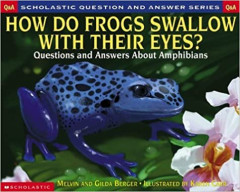
How do frogs swallow with their eyes? : questions and answers about amphibians
From basic questions like, "Do amphibians have ears?" to more involved ones such as "What is an amphibian's best defense?", this title provides answers for even the most inquisitive of young minds. How do frogs swallow with their eyes? Easily. When swallowing a big mouthful of food, a frog blinks its eyes. The blinking pushes the frogs huge eyeballs down on top of its mouth. This helps sque…
- Edition
- -
- ISBN/ISSN
- 9780439266772
- Collation
- 48 pages : illustration ; 20 cm
- Series Title
- Scholastic question and answer series
- Call Number
- 597.8 BER
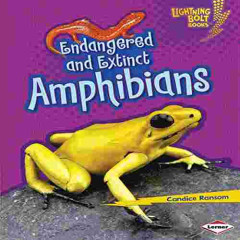
Endangered and extinct amphibians
Hewitt's ghost frogs and arroyo toads are two examples of endangered amphibians. Few of them exist in the wild. Other amphibians have already gone extinct. What hurts these animals? What can you do to help? Read this book to find out!
- Edition
- -
- ISBN/ISSN
- 9781467713320
- Collation
- 32 pages : illustration ; 26 cm
- Series Title
- Lightning Bolt Books
- Call Number
- 591.6 RAN
 Computer Science, Information & General Works
  Philosophy & Psychology
  Religion
  Social Sciences
  Language
  Pure Science
  Applied Sciences
  Art & Recreation
  Literature
  History & Geography