Filter by

The Usborne encyclopedia of ancient Egypt
Introduces the history, government, religion, and culture of ancient Egypt, describes how archaeologists learn about Egyptian civilization, and suggests related Web sites.
- Edition
- -
- ISBN/ISSN
- 9780794522124
- Collation
- 127 pages : illustration ; 28 cm
- Series Title
- -
- Call Number
- 923 HAR

Ancient Greece
Children can unravel ancient secrets in this series of 64 page books. Each includes a timeline, glossary, and index for easy reference, as well as a fully-illustrated display board and a miniature replica to build, along with a handy box for model pieces.In Ancient Greece, readers will gain knowledge of the origins of the Olympic Games, decipher the Greek alphabet, and more. A model of the Part…
- Edition
- -
- ISBN/ISSN
- 157145554X
- Collation
- 61 pages : illustration ; 25 cm
- Series Title
- History in stone
- Call Number
- 938 WIL

Ancient Rome! : exploring the culture, people & ideas of this powerful empire
Examines the history, geography, culture, and politics of the Roman Empire; compares the culture to modern times; and offers ideas for relevant craft projects. Original.
- Edition
- -
- ISBN/ISSN
- 1885593600
- Collation
- 96 pages : illustration ; 25 cm
- Series Title
- Kaleidoscope Kids
- Call Number
- 937 HAR
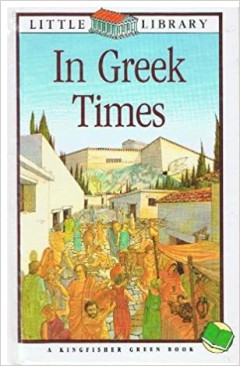
In Greek times
Describing everyday life in Ancient Greece, this book looks at the houses and cities, food, costume, schools, leisure activities, war and beliefs. Activities include making a Greek soldier's shield and hosting your own Olympics.
- Edition
- -
- ISBN/ISSN
- 1856971953
- Collation
- 30 pages : illustration ; 17 cm
- Series Title
- Little Library
- Call Number
- 938 MAY

Ancient Greece
- Edition
- -
- ISBN/ISSN
- 9780750292733
- Collation
- 48 pages : illustration ; 20 cm
- Series Title
- All About....
- Call Number
- 938 CLA
- Edition
- -
- ISBN/ISSN
- 9780750292733
- Collation
- 48 pages : illustration ; 20 cm
- Series Title
- All About....
- Call Number
- 938 CLA

Frozen man
"Getz explains the incredible story of the Iceman clearly and concisely, simply enough for a child to understand but in enough depth to satisfy a curious lay adult." --Kirkus Reviews
- Edition
- -
- ISBN/ISSN
- 0590024175
- Collation
- 68 pages : illustration ; 19 cm
- Series Title
- -
- Call Number
- 937 GET

Roman times
Designed for Key Stage Two, a basic outline of Roman times with activities for children to do, including creating a mosaic or designing a Roman standard. Part of the LITTLE HISTORIES series, illustrated in colour.
- Edition
- -
- ISBN/ISSN
- 0753400715
- Collation
- 30 pages : illustration ; 20 cm
- Series Title
- Little Histories
- Call Number
- 937 ROB

The pharaohs of ancient Egypt
For more than 3,000 years, Egypt was a great civilization that thrived along the banks of the Nile River. But when its cities crumbled to dust, Egypt’s culture and the secrets of its hieroglyphic writings were also lost. The Pharaohs of Ancient Egypt explains how archaeologists have pieced together their discoveries to slowly reveal the history of Egypt’s people, its pharaohs, and its gold…
- Edition
- -
- ISBN/ISSN
- 9780394846996
- Collation
- 180 pages : illustration ; 19 cm
- Series Title
- -
- Call Number
- 932 PAY

Egyptians
Who were the ancient Egyptians? Why did they build pyramids and how were mummies made? These and other questions answered with vivid, full colour illustrations and photographs on every page, and short, informative text. Developed with reading experts at the University of Roehampton for children beginning to read alone.
- Edition
- -
- ISBN/ISSN
- 9780794513443
- Collation
- 32 pages : illustration : 21 cm
- Series Title
- -
- Call Number
- 932 TUR

Terra-cotta soldiers : army of stone
Describes the archaeological discovery of thousands of life-sized terracotta warrior statues in northern China in 1974, and discusses the emperor who had them created and placed near his tomb.
- Edition
- -
- ISBN/ISSN
- 0516250930
- Collation
- 48 pages : illustration ; 21 cm
- Series Title
- High Interest Books
- Call Number
- 931 DEA
 Computer Science, Information & General Works
 Philosophy & Psychology
 Religion
 Social Sciences
 Language
 Pure Science
 Applied Sciences
 Art & Recreation
 Literature
 History & Geography